
For fleet Haldex maintenance, the non-negotiable tasks are to change the coupling oil and filter at defined intervals, inspect the pump screen and electrical connector, check pushrod stroke under pressure, run a diagnostic scan to clear or flag fault codes, and keep OEM service kits on the shelf before a vehicle goes down, not after.
Every scheduled Haldex inspection should cover:
- Coupling oil condition and level check
- Filter removal and replacement
- Pump screen/strainer inspection and cleaning
- Pump electrical connector check for corrosion or damage
- Seals and O-rings inspection for weeping or cracking
- Filler and drain plug torque verification
- Visual scan for external leaks around the coupling housing
- Diagnostic scan for stored fault codes
For routine fluid and filter changes, trained in-house technicians can handle the work provided they follow generation-specific procedures. Escalate to an authorised workshop or Haldex’s own service network when fault codes persist, the pump needs replacement, or the service history is unknown.
Key takeaways
Correct fleet Haldex maintenance requires generation-specific intervals, pump screen inspection at every service, OEM-spec fluids, and documented fault-code checks before and after each job.
| Point | Details |
|---|---|
| Service intervals (Gen 4) | Change coupling oil every 30,000 km; replace the filter every 60,000 km. |
| Pump screen inspection | Inspect and clean the pump screen at every service; a blocked screen is the leading cause of post-service fault codes. |
| Technical tolerances | Check pushrod stroke at 90 psi; oil temp 20–40°C before drain; Gen 4 refill volume per OEM specification. |
| Programme structure | Audit fitments, define duty-cycle-adjusted intervals, assign technician responsibility, and track fault codes per 10,000 km. |
| Haldexparts OEM kits | Platform-matched service kits with correct fluid spec, filter, and seals support warranty documentation and reduce repeat faults. |
Table of Contents
- What does a complete fleet Haldex maintenance checklist look like?
- How often should you service Haldex systems across a fleet?
- What manufacturer support does Haldex offer for fleets?
- Which OEM parts and service kits should your fleet stock?
- How do you build a Haldex maintenance programme for multiple vehicles?
- What are the key technical tolerances technicians need to know?
- Why OEM kits and trained technicians are the practical choice for fleets
- OEM Haldex service kits for fleets: stock the right parts now
- Sources
What does a complete fleet Haldex maintenance checklist look like?
Routine Haldex system servicing is not a single task. It is a sequence of checks that build on each other, and missing one step can leave a fault that a fluid change alone will not fix.
Inspection items:
- Fluid condition: Drain a small sample before the full drain. Dark, metallic-smelling oil or visible particulate means the pump screen needs inspection regardless of mileage.
- Filter: Check it is present and undamaged. A missing or collapsed filter is a red flag for prior DIY work.
- Pump screen/strainer: Remove and inspect. Even light debris accumulation restricts flow enough to trigger fault codes.
- Pump electrical connector: Check for corrosion, bent pins, or moisture ingress. A poor connection mimics pump failure on diagnostics.
- Seals and O-rings: Look for weeping at the drain plug, filler plug, and coupling housing joints.
- Filler/drain plug torque: Verify to manufacturer spec after refill; overtightening strips aluminium threads.
- Visible leaks: Check the underside of the coupling and driveshaft area after a short test drive.
Service tasks in sequence:
- Connect diagnostic tool and record any stored fault codes before disturbing the system.
- Warm the vehicle to bring oil to operating temperature, then allow to cool to 20–40°C before draining (critical on Gen 4 systems, per independent service guidance).
- Remove drain plug and drain fully into a suitable waste-oil container.
- Remove and replace the filter.
- Remove the pump screen/strainer, clean with brake cleaner, inspect mesh for damage.
- Replace all O-rings and seals disturbed during access.
- Refit drain plug to torque; refill with the correct OEM-spec oil to the specified volume.
- Run a pump relearn cycle via diagnostic tool after reinstallation.
- Clear fault codes and re-scan to confirm no new codes are present.
- Short road test, then re-check for leaks.
| Task | How to check | Tolerance/acceptance | Tooling required |
|---|---|---|---|
| Fluid condition | Drain sample before full drain | Clear to amber; no metallic particles | Drain pan, sample pot |
| Filter condition | Visual after removal | Intact mesh, no collapse or bypass damage | Filter removal tool |
| Pump screen | Remove and inspect under light | Clean mesh; no debris accumulation | Torx/hex set, brake cleaner |
| Pump connector | Visual and wiggle test | No corrosion, bent pins, or moisture | Inspection light |
| Seals/O-rings | Visual after drain | No weeping, cracking, or deformation | Pick tool |
| Drain/fill plug torque | Torque wrench after refill | Manufacturer spec (check platform TSB) | Calibrated torque wrench |
| Fault codes post-service | Diagnostic scan | Zero stored codes after clear and relearn | OBD/Haldex-compatible scanner |
Pro Tip: If the drained oil is dark grey or has a metallic sheen, a simple drain-and-fill is not enough. Remove the pump screen and inspect it before refilling. Skipping this step is the most common reason a freshly serviced Haldex continues to generate fault codes within a few thousand kilometres.
How often should you service Haldex systems across a fleet?
Interval policy is where most fleets get it wrong. They apply a single mileage figure to every vehicle regardless of duty cycle, then wonder why some units fail early.
Fourth-generation guidance recommends changing the coupling oil every 30,000 km and replacing the filter every 60,000 km. If the service history is uncertain, the pump and strainer should be cleaned at the first service regardless of mileage. Other generations may carry different manufacturer recommendations, so always confirm against the platform-specific service data before setting fleet policy.
Factors that compress intervals:
- Heavy towing or trailer work accelerates oil degradation through heat cycling
- Stop-start urban duty cycles put more frequent engagement demand on the coupling
- Temperature extremes, particularly sustained sub-zero operation, affect oil viscosity and seal condition
- Vehicles with no documented service history should be treated as overdue regardless of odometer reading
Cost factors to budget:
- Labour: A straightforward fluid and filter change typically takes 45–90 minutes for a trained technician. Add time for pump screen removal and relearn cycles.
- Parts: Oil, filter, drain/fill seals, and O-rings are the baseline. Budget separately for pump seal kits if the pump is being removed for screen cleaning.
- Diagnostics: A pre- and post-service scan adds minimal time but should be costed into every job card.
- Escalation costs: When a pump or control module needs replacement, the job moves from a scheduled service into a repair. Parts costs rise significantly, and if the vehicle is off the road, downtime costs compound quickly.
A routine service that uncovers a blocked screen or a marginal pump connector is a £30–£80 parts job. The same fault found after a coupling failure on the road is a tow, a pump replacement, and potentially a control module. The interval policy pays for itself in that gap.
What manufacturer support does Haldex offer for fleets?
Haldex’s own support structure for fleet operators goes well beyond a parts catalogue. Fleet services include remote diagnostics, an authorised service network, and dedicated technical support for trailer and commercial vehicle fleets. For operators running larger or more complex fleets, the Fleet Plus programme extends this to worldwide parts distribution, online technical advice, field visits, and installation and maintenance training.
When to use each support tier:
- Remote diagnostics: Useful for fault-code interpretation when in-house technicians are uncertain about a stored code’s root cause. Avoids unnecessary parts replacement based on guesswork.
- Technical hotline: Best used when a fault pattern is unusual or when a vehicle has been serviced correctly but continues to generate codes. Haldex technical staff can advise on generation-specific quirks.
- Authorised service network: The right escalation point for pump replacements, control module faults, or any job that requires calibration equipment beyond a standard OBD scanner.
- Haldex Academy / training: Particularly valuable when onboarding new technicians, when a fleet has recently added a new platform, or when fault rates are higher than expected across a vehicle group.
Fleet+ software centralises parts information, technical documentation, service scheduling, and an authorised dealer locator in one place, which reduces the time technicians spend hunting for platform-specific data.
The practical split for most fleets: handle fluid changes, filter replacements, and screen cleaning in-house with trained technicians; escalate pump replacements, persistent fault codes, and warranty-related work to the authorised network.
Which OEM parts and service kits should your fleet stock?
Stocking the right parts before a vehicle needs them is the difference between a same-day turnaround and a vehicle sitting in the yard for three days waiting on a courier.
Core items to hold on the shelf:
- Coupling oil (correct spec for each generation and platform in your fleet)
- Oil filters matched to each platform
- Drain and fill plug seals/crush washers
- O-ring sets for pump and coupling housing
- Pump seal kits for any platform where pump removal is routine
- Spare pump screen/strainer for high-mileage vehicles
Every item in that list is consumable. None of them are expensive individually, but running out of a £4 crush washer at the wrong moment delays a service by a day.
Procurement approach:
Match kits to the Haldex generation fitted to each vehicle in your fleet. Generation 1 through 5 systems use different oil specifications, filter designs, and pump configurations. Buying a kit labelled for the wrong generation is not a minor inconvenience; using the wrong fluid or a mismatched filter can leave the system underperforming even after a correct service procedure, as generation differences affect filter access, screen cleaning, and correct fill volume.
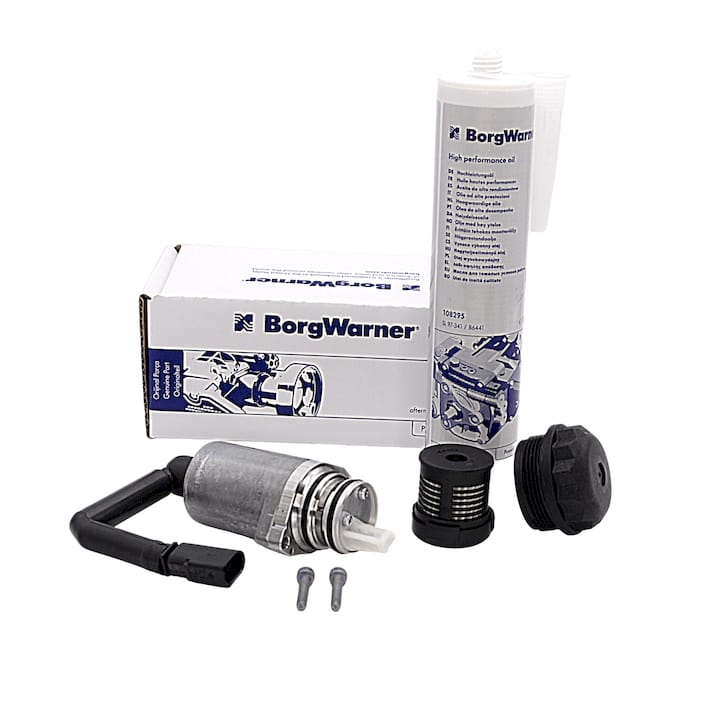
For fleets running multiple brands, Haldexparts stocks platform-matched OEM service kits across Audi, VW, Ford, Land Rover, Volvo, Škoda, Seat, Opel, Saab, and Vauxhall. Kits are selectable by brand and generation, which removes the guesswork from procurement. Bulk ordering is available for B2B accounts, and keeping a documented parts record against each vehicle’s service history supports warranty claims if a component fails within the covered period.
Pro Tip: When ordering for a mixed fleet, group vehicles by Haldex generation first, then by brand. A single bulk order covering all Gen 4 fitments across different marques is more efficient than ordering brand by brand, and it reduces the risk of holding the wrong kit for a vehicle that comes in unexpectedly.
For Haldex pump spares and approved oils, sourcing OEM-grade components ensures the fluid specification and part tolerances match the manufacturer’s design intent, which matters for warranty documentation and for keeping diagnostic baselines consistent across the fleet.
How do you build a Haldex maintenance programme for multiple vehicles?
A fleet maintenance programme for Haldex systems needs a framework, not just a mileage reminder. Without structure, intervals drift, documentation gaps appear, and the first sign of a problem is a vehicle off the road.
Step-by-step framework:
- Audit current fitments: List every vehicle, its Haldex generation, current mileage, and last documented Haldex service. Vehicles with no service record go to the front of the queue.
- Define intervals by duty cycle: Apply the 30,000 km oil / 60,000 km filter baseline for Gen 4, then adjust downward for towing, urban, or temperature-extreme duty. Document the rationale for each interval decision.
- Assign responsibility: Designate which jobs are in-house and which go to the authorised network. Write this into the job-card template so there is no ambiguity when a technician picks up a vehicle.
- Schedule diagnostic scans: Build a pre- and post-service scan into every Haldex job card. Periodic standalone scans (every 15,000 km or at each MOT/inspection) catch developing faults before they become failures.
- Review and adjust: Quarterly, review fault-code frequency and parts consumption. If one platform is generating more codes than others, investigate whether the interval is too long or the procedure is being followed correctly.
KPIs worth tracking:
- Haldex-related vehicle downtime as a percentage of total fleet downtime
- Mean time to repair for Haldex faults (target: same-day for routine service, next-day for pump replacement with parts on shelf)
- Parts-on-shelf rate: percentage of scheduled services completed without a parts delay
- Fault codes per vehicle per 10,000 km, tracked by generation and platform
Questions to ask any supplier or workshop before committing:
- Do you stock generation-specific kits for every platform in our fleet?
- Can you provide documentation for warranty purposes after each service?
- What is your lead time for pump and control module replacements?
- Do your technicians have Haldex-specific training, and when was it last updated?
- Can you support remote diagnostics or provide fault-code interpretation without a physical visit?
For multi-vehicle Haldex service planning, a structured approach to scheduling and documentation reduces both reactive repair costs and the administrative burden of tracking service history across a large fleet. When outsourcing elements of the programme, preventive maintenance specialists who understand fleet scheduling can help define realistic intervals and escalation protocols.
What are the key technical tolerances technicians need to know?
These are the reference values that separate a pass from a flag-for-further-diagnosis during a Haldex inspection.
Brake system checks (per Haldex manufacturer guidance):
- Pushrod stroke must be checked at manufacturer-specified reservoir pressure levels
- Hairline heat checks on drums up to 1 inch are within normal wear parameters; blue spots or deep cracking require drum replacement
- Never mix automatic and manual brake adjusters on the same axle
AWD coupling checks:
- Oil temperature before draining should be within a moderate warm range on Gen 4 systems; draining hot oil gives an inaccurate fill level and risks burns
- Refill volume for Gen 4 applications is typically in the several hundred milliliters range; verify exact platform-specific figure before refilling
- After pump reinstallation, run a pump relearn cycle via a compatible diagnostic tool before road testing
Quick diagnostic steps:
- Connect a compatible OBD or Haldex-specific scanner before any work begins; record all stored codes.
- After fluid and filter change, run the pump relearn procedure. A pump that fails to complete the relearn cycle indicates a mechanical or electrical fault that the fluid change has not resolved.
- If fault codes return within 1,000 km of a service, the pump screen is the first suspect. Remove and inspect before ordering a replacement pump.
- For fault-code interpretation, cross-reference the code against the generation-specific fault table; the same code can indicate different root causes across generations.
Safety note: Contaminated Haldex oil must be treated as hazardous waste. Dispose of drained oil through a licensed waste-oil collector. Never mix Haldex coupling oil with engine oil or gearbox fluid in the same waste container, as this complicates disposal and may breach environmental regulations.
Why OEM kits and trained technicians are the practical choice for fleets
The argument for OEM parts and trained technicians is not about brand loyalty. It is about predictability.
When a fleet runs on aftermarket fluids of uncertain specification, or when a technician follows a generic drain-and-fill procedure without checking the pump screen, the service looks complete on paper. The vehicle goes back into service. Three months later, it generates a fault code, and nobody can explain why because the service record shows the work was done. That is the hidden cost of cutting corners on Haldex servicing: not the parts saving, but the diagnostic time spent chasing a fault that a correct first service would have prevented.
OEM kits carry the correct fluid specification, the right filter design for the generation, and the seal materials that match the coupling’s operating temperatures. When a warranty claim arises, the documentation trail from OEM parts is clean. An aftermarket part that saved £15 on a service kit can complicate a warranty claim worth several hundred pounds.
The practical balance for most fleets is straightforward: train in-house technicians to handle routine fluid changes, filter replacements, and screen cleaning correctly, and escalate to the authorised network for pump replacements and persistent fault patterns. Haldexparts’s technical blog, including the guide on recognising a failing Haldex unit, gives technicians the early-warning signs they need to make that escalation call before a minor fault becomes a major repair.
OEM Haldex service kits for fleets: stock the right parts now
Haldexparts stocks OEM-grade Haldex service kits matched by generation and platform, covering Audi, VW, Ford, Land Rover, Volvo, Škoda, Seat, Opel, Saab, and Vauxhall. Each kit contains the oil, filter, and seals your technicians need to complete a correct service in one visit, with no last-minute parts hunting.
For fleet accounts, bulk ordering is available and every purchase comes with the documentation your team needs to support warranty records. Part lookup works by vehicle and generation, so procurement staff can build a stocking list for the whole fleet in one session rather than searching model by model. Orders over £150 qualify for free shipping, which makes stocking ahead of scheduled services straightforward to justify on cost.
Browse the full OEM parts range at Haldexparts or go directly to the service kit collection to match kits to the platforms in your fleet and place a bulk order today.
Sources
- Haldex recommendations for complete brake maintenance
- Haldex Fleet Plus user guide (exhibit)
- Trailer fleet
- 4th-Generation Haldex - Oil Change. When should you change the oil in the Haldex system?
- How to service Haldex generation 4 full guide
- Haldex oil change service guide - Mechalex