
Haldex flushing is the process of completely replacing the hydraulic fluid and cleaning the internal components of the Haldex all-wheel-drive coupling to prevent contamination-related failures. The industry term for this service is a Haldex oil change, though a proper flush goes well beyond swapping fluid. Skipping it causes clutch slip, restricted oil flow, and eventual AWD failure. This guide explains why haldex needs flushing, what the service actually involves, how often to do it, and what warning signs to watch for before your system fails quietly and expensively.
Why does the Haldex system need flushing?
The Haldex unit relies on hydraulic fluid as both a lubricant and a pressure medium. The fluid powers the electrohydraulic pump, which builds pressure to engage the clutch pack and transfer torque to the rear axle. Without clean fluid, the pump cannot build adequate pressure, and the clutch pack cannot engage properly.
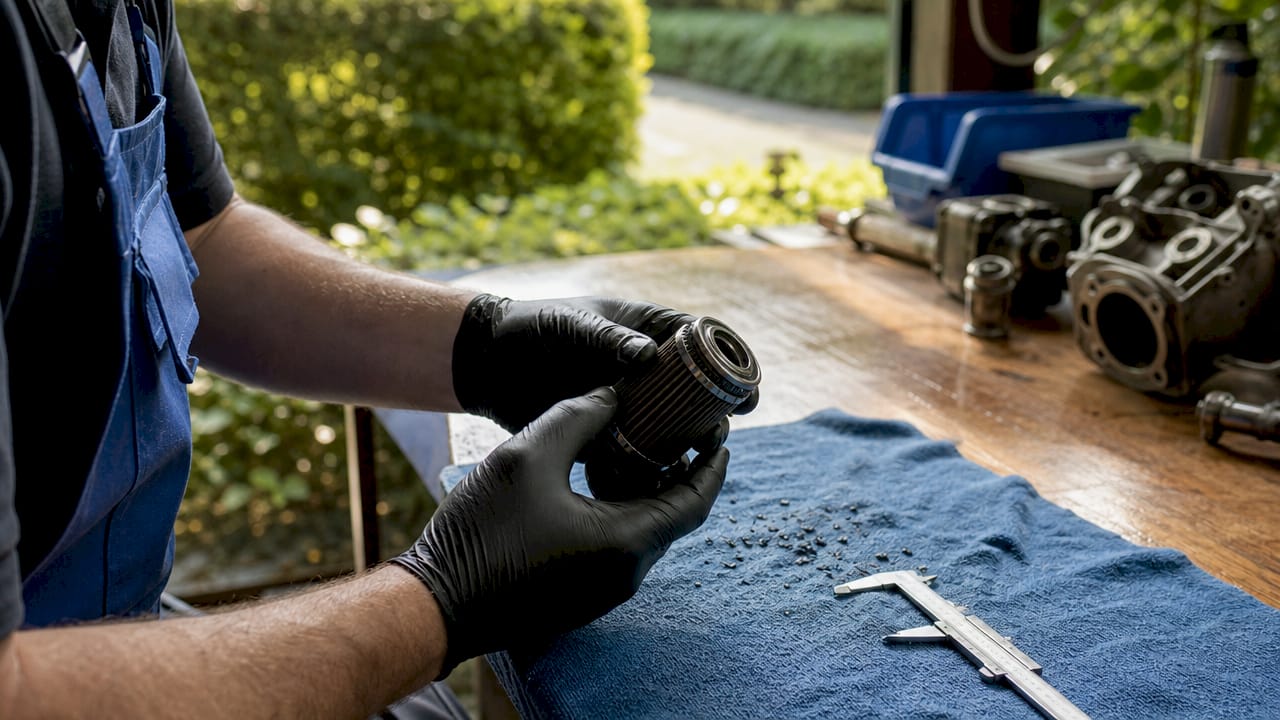
Contaminated fluid restricts oil flow, clogs the filter screen, and causes poor rear axle engagement or complete AWD failure. That is not a gradual inconvenience. It is a direct mechanical consequence of neglect.
Contamination comes from several sources:
- Clutch wear debris. Every time the clutch pack engages, microscopic metal particles shed into the fluid.
- Moisture ingress. Water enters through the breather system, particularly on vehicles driven in wet climates or through standing water.
- Thermal degradation. Heat from repeated engagement breaks down the fluid’s viscosity and additive package over time.
- Pump screen clogging. Debris accumulates on the mesh strainer inside the pump housing, starving the pump of flow.
Water ingress and breather issues are especially common on Land Rover Evoque and similar vehicles used in wet conditions. Once moisture mixes with the fluid, it accelerates corrosion inside the pump and clutch pack.
Pro Tip: Pull the Haldex filter at every service and inspect it before fitting the new one. A filter caked with metallic debris is a clear sign the clutch pack is wearing faster than normal, and you should investigate further before simply refilling.
How often should you flush Haldex fluid?
Experts recommend Haldex service intervals between 20,000 and 40,000 km, depending on driving style and conditions. That range is wide for a reason. A car used for spirited driving or frequent towing degrades its fluid far faster than one covering steady motorway miles.
The table below summarises how different driving profiles affect the recommended interval.
| Driving profile | Recommended interval |
|---|---|
| Spirited or track use | Every 20,000 km |
| Mixed urban and motorway | Every 30,000 km |
| Predominantly motorway | Every 40,000 km |
| Wet climate, stop-start city traffic | Every 20,000–25,000 km |
Regional driving conditions such as frequent rain and stop-start traffic accelerate contamination and shorten service intervals. Cities with high rainfall, heavy congestion, and frequent low-speed AWD engagement put the system under sustained stress. Drivers in those environments should treat 20,000 km as the default, not the exception.
Exceeding the interval does not just degrade performance gradually. Fluid that has broken down completely loses its hydraulic properties. The pump struggles to build pressure, fault codes appear, and the system may default to front-wheel drive only. At that point, a flush alone may not fix the problem. You may need to replace the pump or clutch pack as well.
Pro Tip: Note the mileage on a sticker inside the boot or on the service record every time you flush the system. Haldex intervals are easy to forget because the car gives no obvious reminder until something goes wrong.
What does a proper Haldex flushing service involve?
Haldex flushing is more than a fluid change. It demands system cleaning and diagnostic recalibration to be effective. Treating it as a simple drain-and-fill is the most common mistake DIY owners make, and it leaves the root causes of contamination untouched.
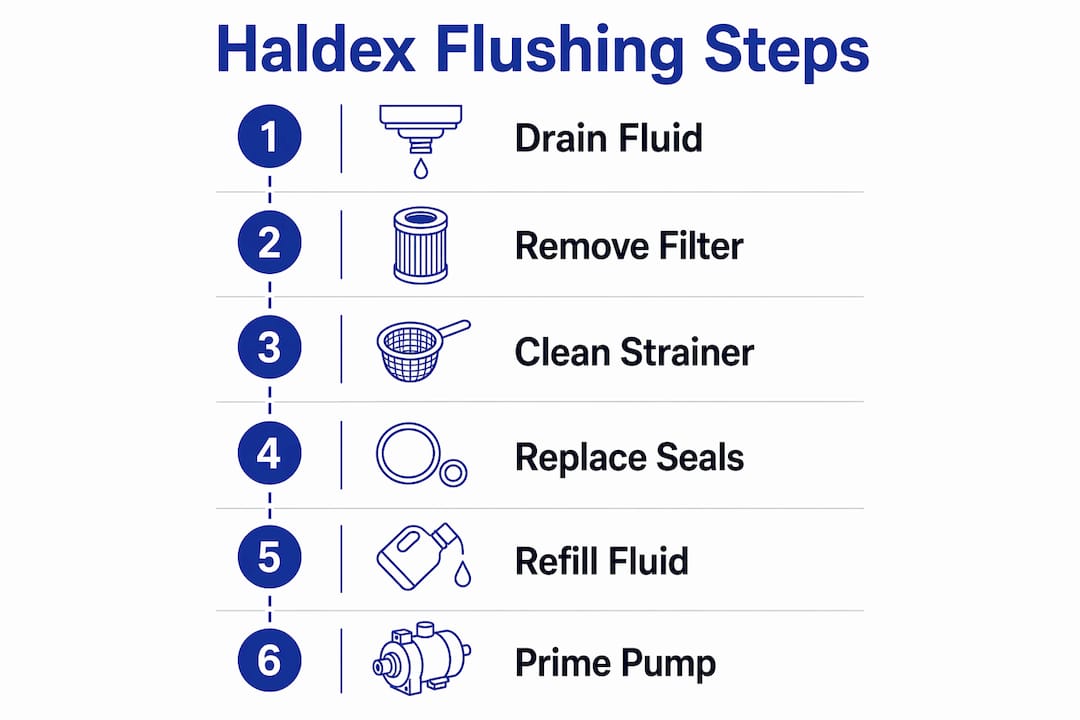
A complete service follows these steps:
- Loosen the fill plug first. Loosening the fill plug before draining is critical. If you drain the oil first and then find the fill plug is seized, you cannot refill the unit. A simple flush becomes a major repair.
- Drain the old fluid completely. Remove the drain plug and allow the unit to drain fully. Partial drains leave contaminated fluid mixed with fresh oil.
- Remove the pump and clean the strainer. The mesh screen inside the pump housing traps debris. Cleaning it thoroughly restores full flow to the pump.
- Replace the pump O-rings and seals. Worn seals cause pressure loss and fluid leaks. Fitting new seals at every service prevents these failures from developing between intervals.
- Fit a new filter. The filter is a consumable. Reusing it defeats the purpose of the service.
- Use the correct fluid type and volume for your generation. Using the correct oil type formulated specifically for the Haldex system is non-negotiable. OEM fluids maintain temperature stability and reduce premature wear. Generic gear oils are not a substitute. Volume varies by generation, so confirm the specification for your vehicle before filling.
- Fill with oil at the correct temperature. Proper filling requires oil temperature between 20°C and 40°C. Filling cold oil into a hot unit, or vice versa, gives an inaccurate level reading.
- Prime the pump using a diagnostic tool. After filling, the pump must be primed using a tool such as VCDS to run a relearn procedure. This ensures the hydraulic system achieves correct operating pressure and clutch engagement. Skipping this step leaves the system underperforming even with fresh fluid.
The steps above apply broadly across generations, though specific torque values, fluid volumes, and diagnostic procedures vary between the 4th and 5th generation units. Always cross-reference the procedure for your specific vehicle.
For a broader understanding of how fluid degradation develops between services, the Haldexparts guide on Haldex oil degradation causes explains the chemistry and prevention in detail.
Pro Tip: If you are doing this for the first time, read the DIY transmission flush guide for general hydraulic fluid handling principles before you start. The Haldex procedure is more specific, but understanding fluid contamination mechanics helps you work more carefully.
What are the signs your Haldex system needs servicing?
Recognising the signs of Haldex issues early saves you from a far more expensive repair. The system rarely fails suddenly. It gives warnings, and most owners miss them because the symptoms are easy to attribute to other causes.
Watch for these indicators:
- Whining or humming from the rear. A whining noise from the Haldex pump is one of the earliest signs of fluid contamination or pump wear. The noise typically increases with vehicle speed.
- Clunking on tight turns. A clunk when turning at low speed suggests the clutch pack is not releasing cleanly, often due to contaminated or degraded fluid.
- Traction irregularities under acceleration. If the rear wheels fail to engage on a slippery surface, or the car pushes understeer where it previously felt balanced, the Haldex coupling is not delivering torque correctly.
- Dashboard warning lights. A differential or AWD warning light combined with a fault code pointing to the Haldex pump or clutch is a direct signal that the system needs attention. Use a diagnostic tool to read the code before assuming a fluid change will fix it.
- Reduced AWD engagement in wet conditions. If the car feels like it is driving on front-wheel drive only in rain or snow, the clutch pack has likely lost the hydraulic pressure needed to engage.
Signs of Haldex issues including whining noises, differential warning lights, and traction irregularities indicate fluid-related problems best addressed through flushing and servicing. Acting on these symptoms promptly, rather than waiting for the next scheduled interval, prevents clutch pack and pump damage that a flush alone cannot reverse.
For a full breakdown of what causes these failures at a component level, the Haldexparts article on Haldex failure causes covers each failure mode in depth.
Key takeaways
Haldex flushing requires complete fluid replacement, strainer cleaning, seal replacement, and pump priming to maintain AWD performance and prevent clutch pack failure.
| Point | Details |
|---|---|
| Flushing is not just an oil change | A complete service includes strainer cleaning, seal replacement, and diagnostic pump priming. |
| Service intervals vary by driving style | Intervals range from 20,000 km for spirited driving to 40,000 km for steady motorway use. |
| Loosen the fill plug first | Always loosen the fill plug before draining to avoid being unable to refill the unit. |
| Use OEM-approved fluid only | Generic gear oils damage the clutch pack; only use fluid formulated for your Haldex generation. |
| Act on symptoms early | Whining, clunking, and traction loss are early warnings. Waiting causes irreversible component damage. |
Why I stopped treating Haldex services as routine oil changes
The first time I saw a Haldex pump fail prematurely, the owner had changed the fluid twice. Both times, the strainer had been left in place and refilled with a generic differential oil. The fluid looked clean. The pump was destroyed.
That experience changed how I approach every Haldex service. The fluid condition is almost irrelevant if the strainer is blocked and the pump seals are weeping. You can put fresh oil into a compromised system and feel nothing change, because the restriction is mechanical, not chemical.
The detail that most DIY guides skip is the pump priming step. Filling the unit and driving away without running a relearn procedure through VCDS or an equivalent tool means the pump does not know its baseline pressure. The system may appear to work, but it is operating on assumptions rather than calibrated values. On a wet roundabout at speed, that difference matters.
My advice for anyone maintaining their own Haldex system: treat the Haldex fault diagnosis guide as required reading before you start. Understanding what the system is trying to tell you through fault codes changes how you approach the physical work. A flush done with that context is a proper service. A flush done without it is an expensive guess.
— Mindaugas
Haldexparts has the parts you need for a complete service
Doing the job properly means having the right parts before you start, not improvising with what is on the shelf.
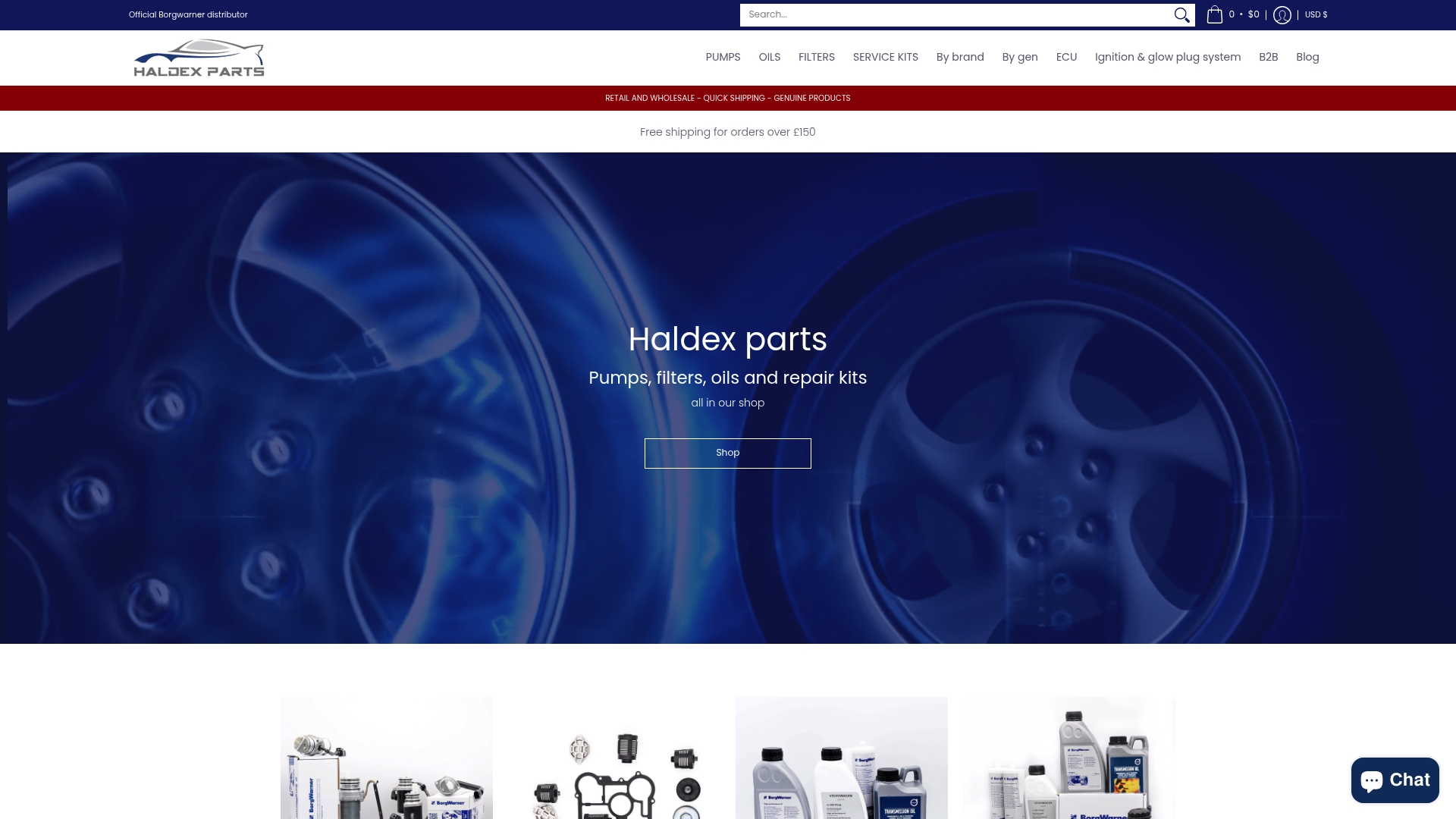
Haldexparts stocks complete Haldex service kits that include OEM-grade oils, filters, and pump seal kits matched to specific vehicle generations and models, covering Audi, VW, Ford, Land Rover, Volvo, and more. Each kit is selected to match the correct fluid specification and component tolerances for your unit, so you are not guessing at compatibility. Orders over £150 qualify for free shipping, and the product listings include generation-specific fitment information to help you order with confidence. If you need oils separately, the Haldex-approved oils range covers every generation currently in service.
FAQ
What is Haldex flushing?
Haldex flushing is the complete replacement of the hydraulic fluid in the Haldex AWD coupling, combined with cleaning the pump strainer, replacing seals and the filter, and priming the pump using a diagnostic tool. It is more involved than a standard oil change.
How often should you service a Haldex system?
Service intervals range from 20,000 to 40,000 km depending on driving style. Spirited or city driving in wet conditions warrants the shorter interval; steady motorway driving can extend to 40,000 km.
Can you use any gear oil in a Haldex system?
No. Only OEM-approved fluid formulated for the Haldex system should be used. Generic gear oils lack the correct additive package and viscosity profile, which accelerates clutch and pump wear.
What happens if you skip the pump priming step?
The pump operates without a calibrated pressure baseline, which means clutch engagement is unreliable. Priming the pump post-fill using a diagnostic tool such as VCDS is required for correct system function after every fluid change.
What are the early signs of Haldex problems?
Whining noises, differential warning lights, and traction irregularities during acceleration are the most common early indicators. Addressing these symptoms promptly through a full service prevents more serious component damage.