
The Haldex AWD system is an electronically controlled, on-demand all-wheel-drive coupling that defaults to front-wheel drive and engages the rear axle within milliseconds when traction drops. Developed originally by Haldex AB and now refined under BorgWarner, the system is fitted to front-wheel-drive platforms from Volkswagen, Audi, Volvo, Ford, and Land Rover. It sits in a category distinct from permanent AWD or mechanical four-wheel drive. Understanding what the Haldex AWD system actually does, how it has changed across five generations, and what it needs to stay healthy will save you money and prevent the kind of failures that catch owners off guard.
How does the haldex AWD system work?
The Haldex system operates on a simple principle: run on the front wheels until the rear wheels are needed, then engage them fast. In practice, the execution is considerably more sophisticated than that summary suggests.
At the heart of the system sits a multi-plate wet clutch pack mounted at the rear differential. A hydraulic pump pressurises the clutch, clamping the plates together to transfer torque rearward. In earlier generations, that pump was driven mechanically by the difference in rotational speed between the front and rear prop shafts. In later generations, an electro-hydraulic pump is controlled directly by the vehicle’s ECU, meaning the system does not need to wait for slip to occur before reacting.
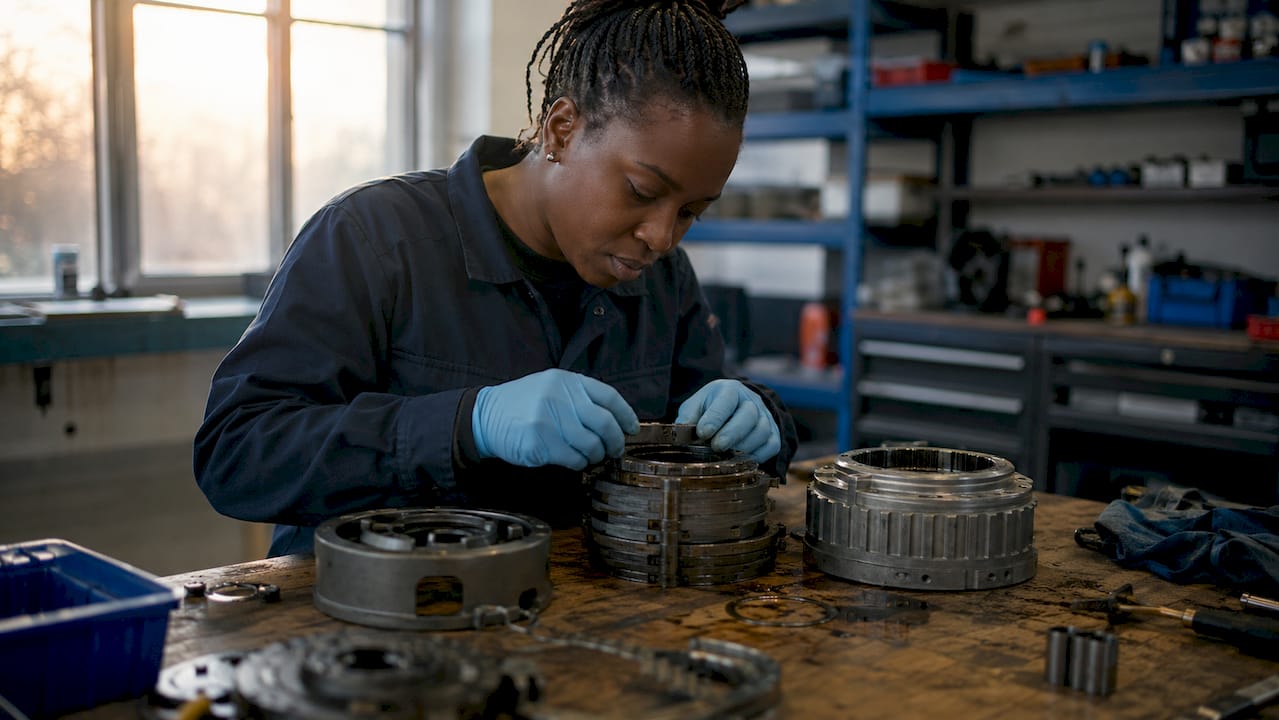
The ECU draws data from the ABS module, ESP sensors, steering angle sensor, and throttle position to calculate how much torque the rear axle should receive at any given moment. This integration means the system can pre-tension the clutch before a corner or before the driver accelerates hard out of a junction. The result is proactive torque distribution rather than a reactive catch-up response.
The system can transfer up to 100% of engine torque to the rear axle depending on the severity of slip. That figure matters because it means the Haldex unit is not simply a mild traction aid. Under the right conditions, it behaves like a genuine AWD system.
Here is how the engagement sequence works in a modern Haldex unit:
- The ECU reads wheel speed, steering input, and throttle data continuously.
- If slip is predicted or detected, the electro-hydraulic pump pressurises the clutch pack.
- Torque transfers rearward in proportion to the calculated demand.
- When traction is restored, clutch pressure releases and the car returns to front-wheel drive.
- The cycle repeats hundreds of times per minute on a demanding road surface.
Pro Tip: If your Haldex-equipped car feels like it is understeering more than usual on a wet roundabout, the system may be defaulting to front-wheel drive due to a sensor fault. Scan for ABS or ESP fault codes before assuming the AWD hardware has failed.
How has the haldex system evolved across five generations?
The Haldex system has changed substantially since its introduction in the late 1990s. The progression from Generation 1 to Generation 5 represents a shift from a purely reactive mechanical device to a software-driven torque management platform.
Key differences across generations:
- Generation 1 and 2: Reactive systems that required approximately a quarter turn of wheel slip before the clutch engaged. Response was noticeable and the mechanical pump wore faster under heavy use.
- Generation 3: Introduced electronic pre-tensioning, allowing the clutch to be partially engaged before slip occurred. A significant step forward in response time.
- Generation 4: Replaced the separate pump and filter assembly with an integrated unit on the rear differential. The ECU gained greater authority over clutch pressure, and software-driven controls replaced much of the mechanical hydraulic logic.
- Generation 5: Further refined the electro-hydraulic architecture. The pump is fully integrated, and torque management is handled almost entirely in software, communicating with the broader vehicle CAN bus network.
Gen 4 and 5 units are visually identifiable by the integrated pump sitting directly on the rear differential housing, whereas earlier units have a separate pump and filter bolted alongside. This distinction matters when ordering service parts.
| Generation | Engagement Type | Pump Design | Key Benefit |
|---|---|---|---|
| Gen 1 and 2 | Reactive (slip required) | Separate mechanical pump | Basic AWD capability |
| Gen 3 | Semi-proactive | Separate electro-hydraulic | Faster response |
| Gen 4 | Proactive, ECU-controlled | Integrated on differential | Reduced complexity |
| Gen 5 | Fully software-driven | Fully integrated | Precision torque management |
BorgWarner’s acquisition and ongoing refinement of the Haldex platform has positioned it as an industry standard for AWD in transverse-engine cars. That is a meaningful endorsement given how many competing solutions exist in the market.
How does haldex AWD compare to other all-wheel-drive systems?
The Haldex system is often grouped with all AWD systems as though they are interchangeable. They are not. The differences affect fuel economy, maintenance cost, and real-world capability.
Full-time AWD systems, such as those found in Subaru’s Symmetrical AWD or Audi’s Torsen-based quattro, distribute power to all four wheels permanently. That delivers consistent traction but at a fuel economy penalty. The Haldex system can improve fuel economy by approximately 2–3 MPG compared to permanent AWD systems, because it runs on two wheels the majority of the time. On a motorway commute, that difference adds up.
JTEKT is another on-demand AWD system found in some Ford Kuga and Ford Escape models. Unlike Haldex, JTEKT uses an electromagnetic clutch pack rather than an electro-hydraulic one. The distinction between Haldex and JTEKT affects repair procedures, service intervals, and parts compatibility. If you own a Ford Kuga, confirming which system is fitted before ordering parts is not optional.
| System | Operation | Fuel Efficiency | Off-Road Suitability |
|---|---|---|---|
| Haldex AWD | On-demand, electro-hydraulic | High | Moderate |
| Torsen quattro | Permanent, mechanical | Lower | High |
| JTEKT | On-demand, electromagnetic | High | Moderate |
| Traditional 4WD | Part-time, manual engagement | Lower | Very high |
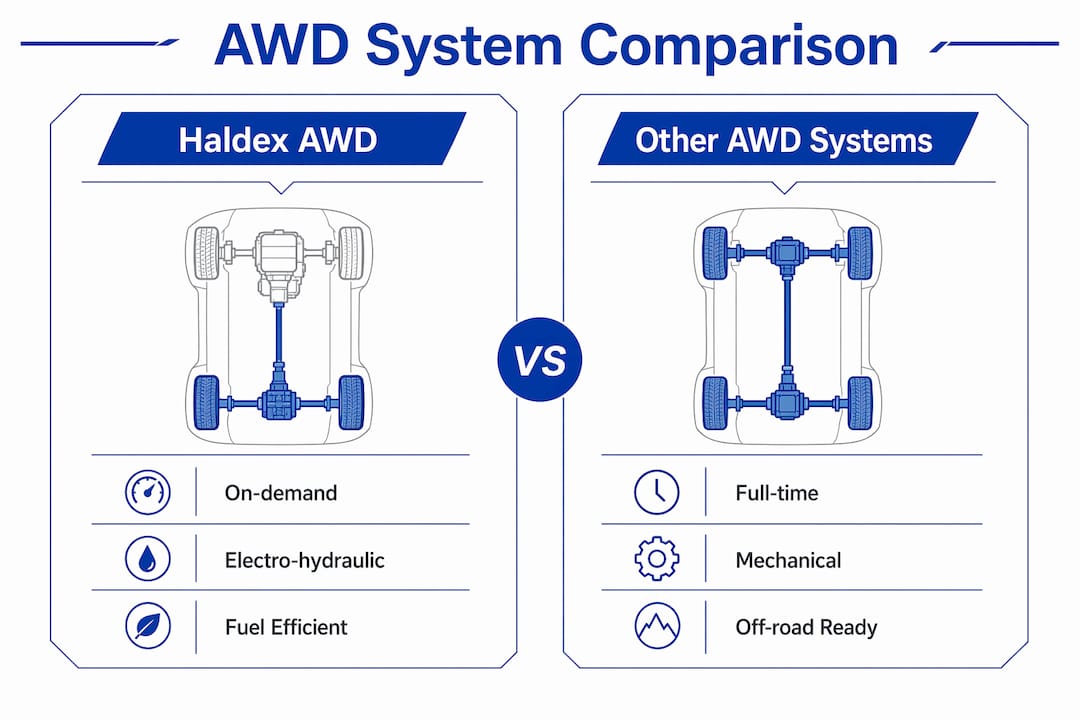
For everyday driving in the UK, where conditions shift between dry motorways and wet country lanes, the Haldex approach delivers a practical balance. It provides fuel-efficient FWD in dry conditions and AWD traction instantly on ice or rain-soaked surfaces. For serious off-road use, a permanent or part-time 4WD system remains the better choice.
What are the maintenance requirements for the haldex system?
The Haldex system is reliable when serviced correctly and expensive when ignored. The most common failure mode is pump damage caused by degraded fluid and a blocked pump screen. This is entirely preventable.
Core maintenance requirements:
- Fluid and filter change every 30,000–40,000 miles. Despite some manufacturers labelling the fluid as lifetime fill, experienced technicians treat this claim with scepticism. Fluid degrades, picks up metal particles, and loses its lubricating properties over time.
- Pump screen cleaning. The internal screen catches debris. A blocked screen starves the pump of fluid and causes premature wear.
- ABS and ESP sensor health checks. The Haldex system relies on ABS and ESP modules for its sensor data. A faulty wheel speed sensor or a CAN bus communication error causes the system to default to front-wheel drive, regardless of the mechanical condition of the clutch unit.
- Visual inspection of the rear differential housing. Look for oil seepage around the pump or filter area, which indicates seal wear.
Common warning signs include a noticeable loss of traction on wet roads, a grinding or whining noise from the rear of the car under load, and AWD warning lights on the dashboard. If you hear unusual sounds from the rear axle area, the Haldex coupling noise guide from Haldexparts covers the diagnostic process in detail.
Understanding what causes Haldex failure almost always points back to one root cause: extended service intervals with degraded fluid. A pump replacement on a Gen 4 or Gen 5 unit costs considerably more than a service kit. The maths strongly favour preventative maintenance.
Pro Tip: When servicing a Gen 4 or Gen 5 Haldex unit, always use fluid approved to the correct specification for your vehicle. Volkswagen and Audi units typically require G 052 175 A2 or G 055 175 A2 specification oil. Using the wrong fluid damages the clutch plates.
Key takeaways
The Haldex AWD system delivers on-demand all-wheel drive by combining an electro-hydraulic clutch pack with ECU-controlled torque management, making proactive servicing the single most important factor in long-term reliability.
| Point | Details |
|---|---|
| On-demand by design | Haldex defaults to front-wheel drive and engages the rear axle only when traction data demands it. |
| Five generations of development | Each generation improved response speed, moving from reactive slip detection to proactive software control. |
| Fuel efficiency advantage | The system saves approximately 2–3 MPG compared to permanent AWD by running on two wheels in normal conditions. |
| Sensor dependency | ABS and ESP sensor faults cause the system to fall back to front-wheel drive, so electrical health matters as much as mechanical condition. |
| Service intervals are critical | Fluid and filter changes every 30,000–40,000 miles prevent pump failure, the most common and costly Haldex repair. |
Why i think most haldex owners are servicing their cars too late
Having spent years working through the specifics of AWD systems, the pattern I see most often is this: owners discover the Haldex system exists at the point it fails. They buy a Volkswagen Tiguan, an Audi Q3, or a Volvo XC60 because it has AWD, and they assume the AWD looks after itself. It does not.
The “lifetime fluid” label is the single most damaging piece of misinformation in this space. Manufacturers use it to reduce warranty service costs. Technicians who open a neglected Gen 3 or Gen 4 unit after 80,000 miles of no service find fluid that looks like dark treacle and a pump screen so blocked it is barely functional. The pump then fails. The repair bill follows.
What I find genuinely impressive about the later Haldex generations is the software integration. A Gen 5 unit in a modern Audi or VW is not just a coupling. It is a node in the vehicle’s stability network, reading data from multiple modules and making torque decisions faster than any mechanical system could. That sophistication is exactly why the fluid quality matters so much. The clutch plates operate under high pressure and temperature. Degraded fluid accelerates wear on those plates in ways that are invisible until the system stops working.
My practical advice: treat the Haldex service interval as 30,000 miles regardless of what the handbook says. Use the correct OEM-specification fluid. Check your ABS sensor codes at every service. And if you are buying a used Haldex vehicle, ask for documented service history on the rear differential specifically, not just the engine.
— Mindaugas
Get the right parts for your haldex service
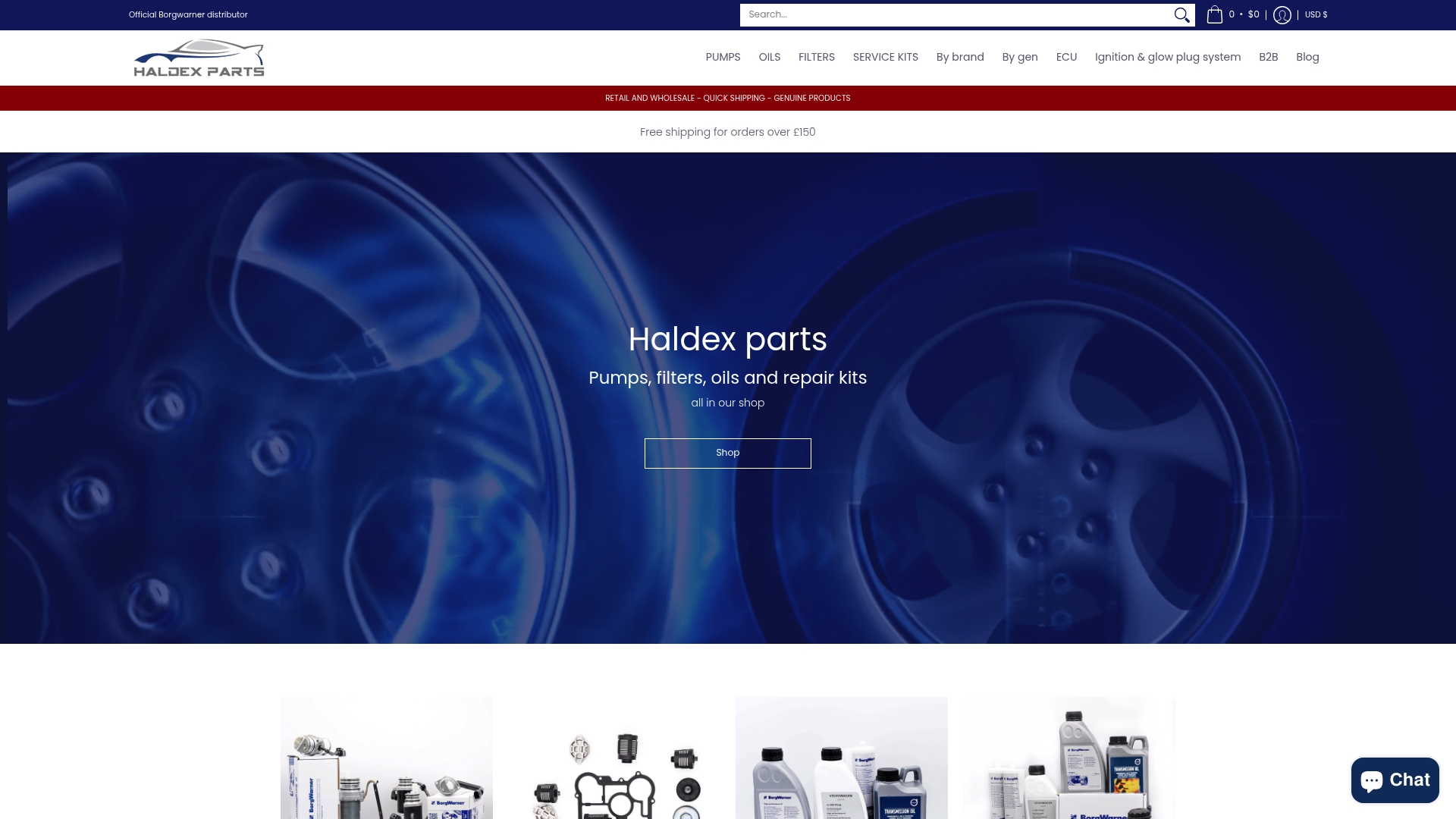
Keeping your Haldex system in good condition starts with using the right components. Haldexparts stocks OEM-grade Haldex service kits covering Audi, VW, Ford, Volvo, and Land Rover applications, with kits that include the correct oils, filters, and pumps for each generation. Every product listing includes vehicle-specific fitment information, so you order with confidence rather than guesswork. If you need a replacement AWD pump motor or generation-specific Haldex oil, Haldexparts carries the full range with free delivery on orders over £150. Fast despatch and clear technical guidance make it the practical choice for both DIY owners and workshop professionals.
FAQ
What is the haldex AWD system in simple terms?
The Haldex AWD system is an on-demand all-wheel-drive coupling that normally drives the front wheels and automatically sends torque to the rear axle when traction is lost. It uses a hydraulically controlled clutch pack managed by the vehicle’s ECU.
What vehicles use the haldex AWD system?
Volkswagen, Audi, Volvo, Ford, and Land Rover all use Haldex or BorgWarner-derived AWD systems across models including the VW Tiguan, Audi Q3, Volvo XC60, Ford Kuga, and Land Rover Freelander.
How often should haldex fluid be changed?
Fluid and filter changes are recommended every 30,000–40,000 miles. Despite some manufacturers claiming lifetime fluid, expert technicians advise regular changes to prevent pump failure.
What is the difference between haldex and JTEKT AWD?
Haldex uses an electro-hydraulic clutch pack, while JTEKT uses an electromagnetic clutch system. The two are not interchangeable in terms of parts or service procedures, which matters particularly for Ford Kuga owners confirming which system their vehicle carries.
What are the signs of a failing haldex system?
Common signs include increased understeer on wet roads, a whining or grinding noise from the rear axle under load, and AWD warning lights on the dashboard. Sensor faults in the ABS or ESP system can also cause the unit to default to front-wheel drive without any mechanical fault present.