
Upgraded Haldex oil is a specialised hydraulic fluid that sustains rear-axle engagement, clutch actuation, and pump lubrication in all-wheel-drive coupling systems. It is not simply a lubricant. Haldex oil actively influences clutch behaviour and pump function, making fluid quality a direct factor in AWD reliability. Understanding why upgraded Haldex oil matters is the difference between a system that responds instantly and one that quietly degrades until it fails. Vehicles from Audi, VW, Volvo, Ford, and Land Rover all depend on this fluid to keep their Haldex units working as designed.
Why upgraded Haldex oil matters for your AWD system
The Haldex coupling, developed by BorgWarner, uses hydraulic pressure to engage the rear axle when the front wheels slip. That pressure comes entirely from the oil circulating through a small electric pump. Without the right fluid in good condition, the pump cannot build adequate pressure, and rear-axle engagement becomes slow, inconsistent, or absent altogether.
Neglecting fluid quality leads to reduced rear engagement, uneven traction, warning lights, and, in the worst cases, total Haldex failure. A failed Haldex unit effectively turns your AWD vehicle into a front-wheel-drive car. That is a significant safety and performance compromise, particularly in wet or low-grip conditions.
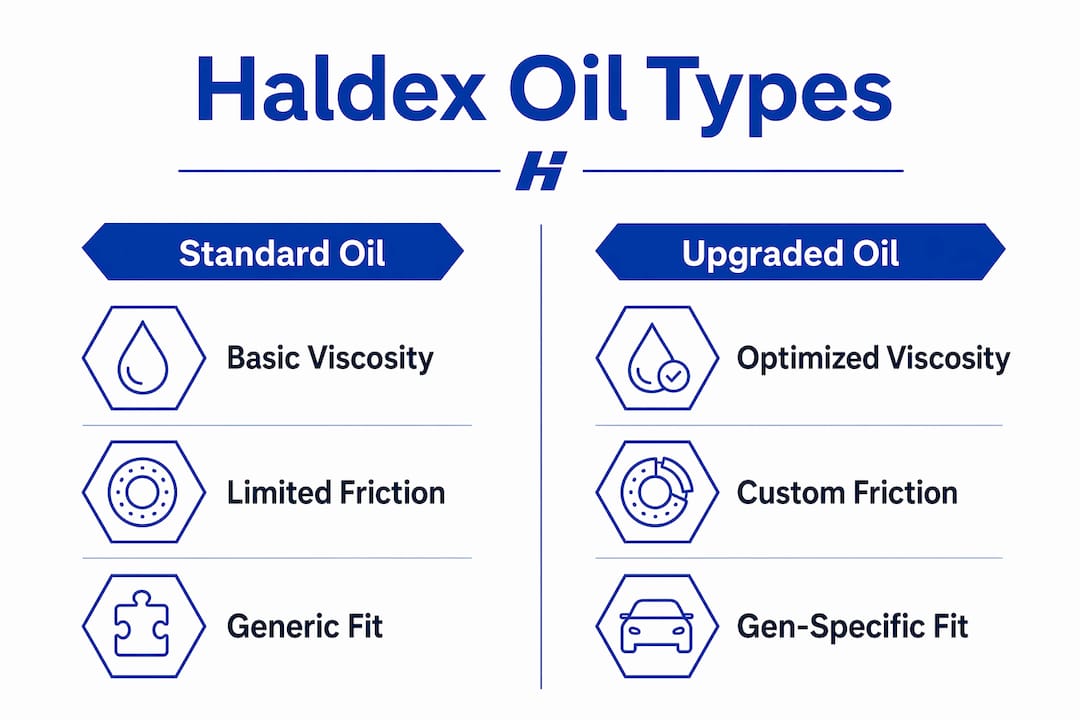
Upgraded oil, matched to your specific Haldex generation, maintains the correct viscosity and friction characteristics the clutch pack requires. Standard or degraded oil loses these properties over time. The result is a system that cannot do the job it was engineered to do.

What happens when you use degraded or incorrect Haldex fluid?
Degraded Haldex oil carries contamination from clutch debris, metal particles, and moisture. This contamination restricts hydraulic flow through the pump and clogs the pickup screen. Dirty oil and clogged pump screens reduce flow, strain the pump, and cause clutch packing wear, leading to AWD system failures.
The symptoms are not always obvious at first. You may notice the AWD warning light appearing intermittently, a slight hesitation when pulling away on a slippery surface, or a feeling that the rear axle is not contributing during cornering. These are early signs that fluid quality has dropped below the threshold the system needs.
“Maintaining correct fluid condition is proactive protection for AWD drivability, avoiding sudden failures.” — Mechalex Service Guide
Waiting for a warning light before acting is a costly strategy. By the time a fault code appears, the pump may already be under significant stress. Replacing pumps without correcting oil quality is expensive and ineffective. The root cause remains, and the new pump degrades just as quickly.
Pro Tip: If your AWD warning light has appeared and then cleared itself, do not ignore it. Run a diagnostic scan and check fluid condition before assuming the fault has resolved.
The consequences of neglect extend beyond the pump. Worn clutch packs are expensive to replace, and the labour involved in accessing a Haldex unit adds significantly to the bill. Proactive fluid maintenance costs a fraction of that repair.
Upgraded vs standard Haldex oil: does generation matter?
Not all Haldex fluids are interchangeable. Different BorgWarner Haldex generations demand specific fluid formulations, and using the wrong oil can impair clutch behaviour and pump lubrication. Gen I fluids differ significantly from those used in Gen II through Gen V units. The friction modifiers, viscosity index, and additive packages are all calibrated differently.
Manufacturers such as MPM Oil offer OEM-approved fluids tailored for generation-specific clutches and pumps. Using a fluid that meets the correct OEM approval is not optional. It is the only way to guarantee the clutch pack behaves as designed under load.
| Haldex generation | Fluid type | Key characteristic | OEM approval example |
|---|---|---|---|
| Gen I | G052175A1 | Higher viscosity, specific friction modifiers | VW/Audi G052175A1 |
| Gen II–III | Generation-specific formulation | Revised friction package for updated clutch | BorgWarner Gen II–III spec |
| Gen IV–V | Low-viscosity hydraulic fluid | Optimised for faster clutch response | BorgWarner Gen IV–V spec |
The table above shows why selecting the correct generation fluid is not a minor detail. A Gen I fluid used in a Gen IV unit will not provide the right friction characteristics. The clutch may slip under load or engage too aggressively, both of which accelerate wear.
Pro Tip: Always confirm your Haldex generation before ordering fluid. Check your vehicle’s build date and model variant, as the same car model was sometimes produced with different Haldex generations across production years.
Later generation units also have a different filtration setup. Some newer Haldex units lack a separate filter, so cleaning the pump strainer and replacing seals during an oil change becomes the critical service step. Skipping this on a Gen V unit is a common mistake that leaves contamination in the system even after a fluid change.
How to maintain your Haldex system with upgraded oil
Proper Haldex maintenance follows a clear process. The service interval and procedure depend on your generation and how you use the vehicle.
- Check your service interval. VAG Haldex systems typically require fluid service every 30,000–40,000 miles or 3 years. That is the baseline for normal use.
- Adjust for your driving style. Short trips, stop-start traffic, towing, and spirited driving accelerate oil contamination. If any of these apply to you, shorten the interval to 20,000–25,000 miles.
- Drain completely. A partial drain leaves contaminated fluid in the system. Always drain fully and allow the unit to settle before refilling.
- Clean the pump strainer. On Gen IV and Gen V units, remove the pump and clean the pickup screen thoroughly. Debris left here will contaminate the new fluid within a short mileage.
- Replace seals where required. On Gen V units, replacing the pump seals during an oil change is standard practice. Worn seals allow pressure to bleed off, reducing engagement speed.
- Refill with the correct fluid volume. Overfilling or underfilling affects hydraulic pressure. Use the exact volume specified for your generation.
- Run diagnostics after the service. Post-service diagnostics distinguish fluid-related issues from electrical or control faults. Skipping this step risks missing a fault code that points to a separate problem.
Understanding what triggers Haldex engagement helps you appreciate why each of these steps matters. Hydraulic pressure is the trigger. Every step in the service process either protects or restores that pressure.
Pro Tip: After refilling, drive the vehicle through several low-speed turns on a quiet road. This primes the system and allows you to feel whether rear engagement is responsive before returning to normal driving.
Common mistakes that undermine Haldex oil changes
Several errors are widespread among owners who service their own Haldex units or use workshops unfamiliar with the system.
- Treating Haldex oil as a lifetime fluid. Many owners mistakenly view Haldex units as sealed-for-life systems, delaying oil changes until failure symptoms appear. No Haldex fluid is genuinely lifetime. Contamination builds regardless of mileage.
- Using any available ATF or differential fluid. Haldex oil is not interchangeable with standard automatic transmission fluid or rear differential oil. The friction modifiers are different, and using the wrong product damages the clutch pack.
- Skipping the pump strainer clean. Draining and refilling without cleaning the strainer leaves the primary contamination source in place. The new fluid degrades far faster as a result.
- Ignoring the filter on earlier generations. Gen I, II, and III units have a replaceable filter element. Changing the oil without replacing the filter is an incomplete service. You can read more about this in Haldexparts’ guide on how an upgraded filter improves Haldex flow.
- Assuming a warning light clears the problem. A fault code that disappears after a restart does not mean the issue is resolved. It often means the system has adapted temporarily. Diagnostics are the only reliable check.
- Delaying service until AWD function is noticeably poor. By that point, clutch pack wear is often already significant. The benefits of upgraded oil are greatest when the system is still in good condition.
Understanding what causes Haldex failure in detail helps you see how many failures trace back to these avoidable errors. Upgraded oil combined with correct servicing removes most of the risk.
Key takeaways
Upgraded, generation-specific Haldex oil is the single most cost-effective measure for maintaining AWD reliability, preventing pump failure, and preserving clutch pack condition across all Haldex generations.
| Point | Details |
|---|---|
| Oil is a hydraulic fluid, not just lubricant | Haldex oil builds the pressure that triggers rear-axle engagement; quality directly affects AWD response. |
| Generation matching is non-negotiable | Gen I fluid is incompatible with Gen II–V units; always confirm your generation before purchasing. |
| Service every 30,000–40,000 miles | Shorten the interval for towing, stop-start use, or spirited driving to prevent accelerated contamination. |
| Clean the strainer, not just the fluid | Replacing oil without cleaning the pump pickup screen leaves the main contamination source in place. |
| Post-service diagnostics prevent misdiagnosis | Running a scan after an oil change confirms whether remaining faults are fluid-related or electrical. |
Haldex oil: what I have learned from getting it wrong first
The first time I serviced a Haldex unit on a Mk5 Golf R32, I drained the oil, refilled with a compatible fluid, and considered the job done. The AWD warning light returned within 3,000 miles. The pump strainer was blocked with clutch debris I had left untouched. That mistake cost more in diagnostic time than the original service.
The lesson I took from that is that Haldex servicing is not like changing engine oil. The system is small, the oil volume is modest, and every step in the procedure matters. Cutting one corner compounds the next problem.
I have also seen owners buy the cheapest fluid labelled as “Haldex compatible” without checking the generation. On a Gen IV unit, the wrong friction modifiers cause the clutch to engage harshly, which accelerates wear on the steel and friction plates. The damage is not immediate, but it is cumulative. By the time you notice inconsistent AWD behaviour, the clutch pack is already compromised.
My honest recommendation is to use OEM-approved fluid from a supplier who lists compatibility by generation, not just by brand. Haldexparts stocks generation-specific oils and lists vehicle compatibility clearly, which removes the guesswork from selection. Pair the fluid change with a filter replacement on earlier generations and a strainer clean on later ones. Then run diagnostics. That complete process is what actually protects the system.
— Mindaugas
Haldexparts: generation-specific oils and service kits
Haldexparts stocks OEM-grade Haldex fluids and complete service kits matched to specific vehicle generations, covering Audi, VW, Volvo, Ford, Land Rover, and more.
Every kit includes the correct fluid volume, filter where applicable, and seals for a thorough service. Orders over £150 qualify for free shipping, which makes ordering a full service kit straightforward. The Haldex service kits page lists kits by generation and vehicle, so you can confirm compatibility before ordering. For fluid-only purchases, the Haldex oils catalogue covers generation-specific options including OEM-approved products for Gen I through Gen V systems. If you need guidance on which kit suits your vehicle, the product pages include detailed fitment information.
FAQ
What is Haldex oil and why does it need upgrading?
Haldex oil is a specialised hydraulic fluid that builds pressure for rear-axle engagement and lubricates the clutch pack and pump. Upgrading to a generation-specific, OEM-approved fluid maintains the correct friction characteristics and prevents contamination-related damage.
How often should Haldex oil be changed?
VAG Haldex systems require a fluid change every 30,000–40,000 miles or every 3 years under normal use. Stop-start driving, towing, or spirited use warrants a shorter interval of around 20,000–25,000 miles.
Can I use any differential fluid in a Haldex unit?
No. Haldex oil has specific friction modifiers and viscosity requirements that standard differential or ATF fluids do not meet. Using the wrong fluid damages the clutch pack and impairs pump lubrication.
Does Haldex generation affect which oil I should use?
Yes. Gen I fluids are not compatible with Gen II–V units, and vice versa. Each generation has a distinct fluid specification tied to its clutch design and pump requirements.
What happens if I skip the pump strainer clean during a fluid change?
Leaving the pump strainer blocked with clutch debris means the new fluid becomes contaminated quickly. The pump works harder, pressure drops, and AWD engagement becomes inconsistent, often within a few thousand miles of the service.