

AWD system service best practices are defined as the scheduled, specification-led procedures that preserve drivetrain integrity, prevent fluid contamination, and maintain traction system performance across all driving conditions. For VAG Haldex units fitted to Audi, VW, Skoda, and SEAT models, the baseline service interval is every 3 years or 30,000–40,000 miles. That figure exists because the Haldex unit carries a small oil volume under continuous pump load, which accelerates contamination far faster than a conventional gearbox. Neglecting this schedule does not just shorten component life. It causes pump seizure, clutch wear, and drivetrain failures that cost multiples of a routine service.
1. What are the correct fluid service intervals for AWD systems?
The single most important variable in AWD maintenance is fluid change frequency. Contaminated fluid is the leading cause of Haldex pump failure, and the damage often occurs before any warning light appears.
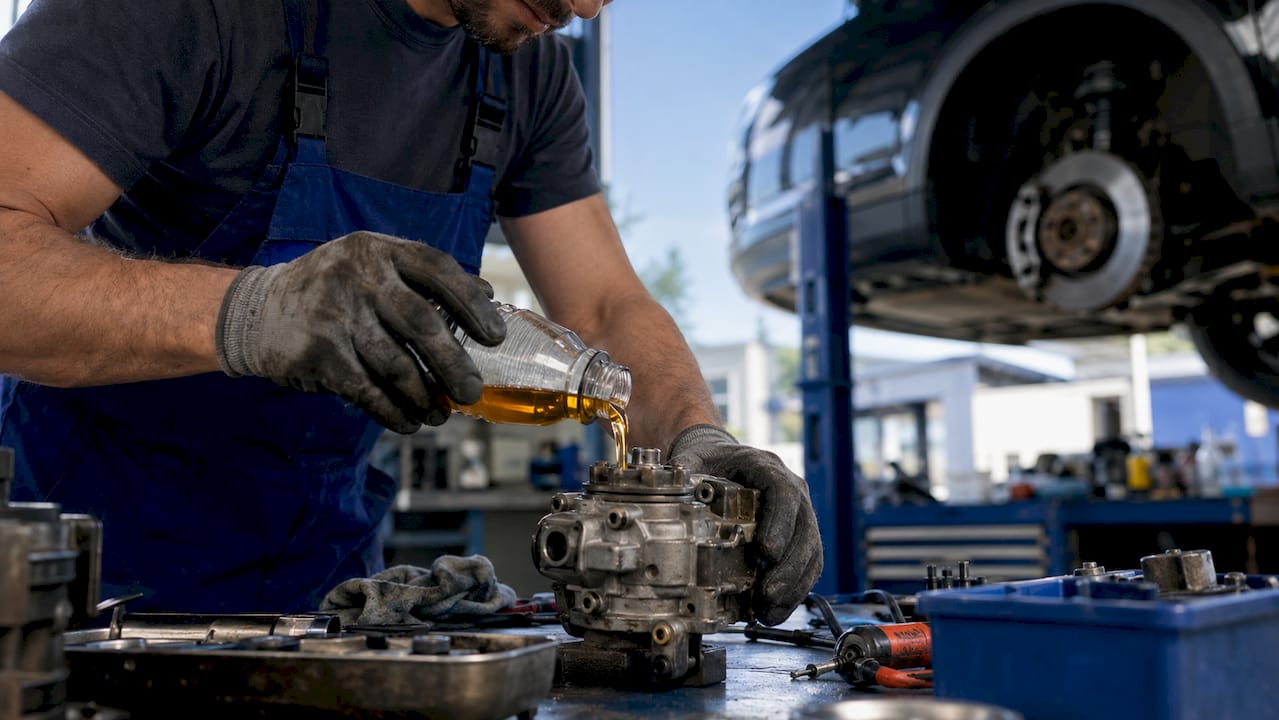
Standard intervals for VAG-style Haldex systems sit at 3 years or 30,000–40,000 miles. These baselines assume mixed driving on well-maintained roads. They are not suitable for every application.
Severe-duty use changes the calculation entirely. Towing, track days, repeated short trips, and performance driving all accelerate fluid breakdown. For these applications, intervals should be reduced by 30–50%, bringing the practical service window to 15,000–20,000 miles. That is not a conservative estimate. It is the figure that prevents unplanned failures.
Every fluid service must include a filter change. Running fresh oil through a saturated filter defeats the purpose of the service. The replacement fluid must also match the manufacturer’s specification exactly. Off-spec fluid alters viscosity and clutch engagement behaviour, which the AWD controller cannot compensate for.
- Change fluid and filter together, every service without exception
- Use only manufacturer-specified fluid for the generation of Haldex fitted to the vehicle
- Reduce intervals to 15,000–20,000 miles for towing, track, or high-load use
- Never skip the filter when changing fluid
Pro Tip: If the vehicle has a DSG gearbox, align the Haldex service with the DSG fluid change. Both share similar contamination timelines and combining them reduces labour time and the risk of one being overlooked.
2. Why fluid servicing alone is not enough: pump cycling and adaptations
A Haldex service is not complete after draining and refilling the oil. The service requires pump cycling and software adaptations via a diagnostic tool to prevent immediate hydraulic pump damage. This step is non-negotiable.
When fresh oil enters the system, the pump must be commanded through a priming cycle to purge air and distribute fluid correctly. Skipping this step leaves the pump running dry on its first engagement, which causes scoring of internal components within seconds. The adaptation procedure also resets learned values in the AWD controller, allowing it to recalibrate clutch engagement to the new fluid’s characteristics.
This is the step that separates a proper Haldex service from a fluid top-up. Any workshop performing Haldex maintenance without a compatible diagnostic tool is not completing the job. Professionals should verify that the tool supports pump commands and adaptation resets for the specific Haldex generation fitted.
3. How tyre management affects AWD system performance
Tyre uniformity is the most underestimated factor in AWD system longevity. AWD tread depth must not vary by more than 2/32 inch across all four tyres. Exceeding that tolerance forces the AWD controller to make continuous torque corrections, which generates heat and accelerates clutch wear.
Modern AWD systems monitor wheel speed continuously, reading data multiple times per second. When tyre circumferences differ due to mismatched wear or mixed tyre sizes, the system interprets the speed difference as wheel slip. It responds by engaging the rear clutch pack, which was not designed for sustained corrective load.
The consequences are predictable. Overheating, premature clutch failure, and differential damage follow mismatched tyres far more reliably than most professionals expect. The fix is straightforward but requires discipline.
- Replace AWD tyres in sets of four, not pairs
- Match brand, model, and tread pattern across all four positions
- Rotate tyres every 6,000–8,000 miles to maintain even wear
- Check tread depth across all four tyres at every service visit
Pro Tip: When one tyre is damaged beyond repair on an AWD vehicle with low-mileage tyres, shaving the new tyre to match the existing tread depth is a legitimate option. It protects the drivetrain without requiring a full set replacement.
Understanding why oil degrades in Haldex units helps explain why tyre-induced stress compounds fluid breakdown so quickly.
4. What diagnostic procedures catch AWD faults early?
Effective AWD diagnostics combine fault code scanning, physical inspection, and functional testing. No single method catches everything. Diagnostics must cover pressure faults, pump strain codes, and seal integrity to give a complete picture of system health.
Fault code scanning identifies electrical faults, pressure sensor anomalies, and pump overload events. These codes often appear before any physical symptom is noticeable. Reading them at every service interval gives professionals a trend view of system behaviour rather than a single snapshot.
Physical inspection covers seals, CV boots, and wiring harnesses. Neglected seals and CV boots allow water ingress, which contaminates AWD fluid and causes corrosion inside the unit. Salt, mud, and moisture accelerate this process significantly on vehicles used in winter conditions.
- Scan for fault codes covering pump, pressure, and clutch engagement systems
- Inspect all seals, CV boots, and wiring harnesses for cracking or damage
- Perform a functional coupling cycle test after every fluid service
- Check for unusual noises, vibrations, or traction control anomalies during a road test
- Verify that adaptation and relearning procedures complete without errors post-service
Pro Tip: Carry out a full undercarriage inspection after the first warm spell following winter. Salt and road debris accumulate in areas that are invisible during routine checks, and seal deterioration accelerates when temperatures fluctuate.
The Haldex controller plays a central role in adaptation procedures, and understanding its function helps technicians interpret relearning errors correctly.
5. Seasonal service windows and fleet AWD maintenance strategies
Timing AWD services around seasonal exposure is one of the highest-return decisions a professional or fleet manager can make. The two most effective service windows are late october and late april. The first addresses pre-winter preparation. The second removes salt and contamination accumulated over the winter months.
Salt exposure corrodes seals, degrades fluid, and accelerates wear on every external component of the AWD unit. Servicing after the last salt application of the season removes contaminated fluid before it has time to attack internal surfaces. This single habit extends service life measurably.
Proactive scheduled AWD maintenance reduces annual repair costs by up to 35% by preventing emergency breakdowns. For fleet operators, that figure translates directly into vehicle availability and reduced unplanned downtime.
Fleet operators benefit from structured preventive maintenance scheduling, which applies fixed mileage and calendar triggers rather than relying on driver-reported symptoms. Symptom-based maintenance always arrives late. By the time a driver notices a problem, the damage is already done.
Additional practices that protect AWD systems across a fleet or enthusiast garage:
- Never tow an AWD vehicle with driven wheels on the ground. Flatbed transport only protects differentials and transfer cases from rotational damage
- Avoid applying the handbrake while the vehicle is moving, which stresses the rear drivetrain
- For track or off-road use, reduce service intervals to the severe-duty schedule immediately
- Use digital maintenance logs to track mileage, fluid type, and service dates per vehicle
Thermal management also matters. Aggressive driving raises AWD fluid temperatures rapidly. Allowing the system to cool before parking after hard use reduces the rate at which fluid oxidises between service intervals.
For a broader view of seasonal vehicle maintenance, including corrosion checks relevant to AWD systems, the timing principles apply across the full drivetrain.
6. Recognising the signs of AWD system degradation
AWD system degradation rarely announces itself clearly. The symptoms are subtle until the damage is severe. Knowing what to look for separates professionals who catch problems early from those who replace components after failure.
Unusual vibrations under acceleration, particularly when cornering, indicate clutch pack wear or fluid breakdown. Traction control warning lights that activate on dry roads suggest the AWD controller is receiving inconsistent wheel speed data, often caused by tyre mismatch or a failing sensor. A whining noise from the rear of the vehicle under load points to pump strain or low fluid pressure.
Fluid colour tells its own story. Fresh Haldex fluid is a clear amber. Fluid that has turned dark brown or carries a burnt smell has exceeded its service life. Running the system on degraded fluid compounds wear with every mile. Professionals should check fluid condition visually at every inspection, not just at scheduled service intervals.
Understanding what causes Haldex failure in detail helps technicians connect early symptoms to their root causes before the repair bill escalates.
Key takeaways
AWD system service best practices require scheduled fluid changes, tyre uniformity, thorough diagnostics, and seasonal timing to prevent drivetrain failure and preserve long-term performance.
| Point | Details |
|---|---|
| Fluid interval discipline | Service VAG Haldex units every 3 years or 30,000–40,000 miles; halve this for severe use. |
| Pump cycling is mandatory | Always complete software adaptations and pump priming after every fluid change. |
| Tyre uniformity protects the drivetrain | Keep tread depth variation within 2/32 inch across all four tyres to avoid clutch damage. |
| Seasonal timing maximises protection | Service before and after winter salt exposure to limit corrosion and fluid contamination. |
| Diagnostics must be multi-layered | Combine fault code scanning, physical inspection, and functional testing at every service. |
What I have learned from years of AWD servicing
The most expensive AWD repairs I have seen share one common factor: the owner believed the fluid was “sealed for life.” No Haldex unit is sealed for life. That phrase was never accurate for a system with a hydraulic pump running under continuous load in a small oil volume. It is a misconception that costs people thousands of pounds.
The subtlety of AWD degradation is what makes it dangerous. The system does not fail dramatically. It degrades quietly over thousands of miles, and by the time the driver notices something is wrong, the clutch pack or pump is already compromised. Diagnostic tools change this. A technician who reads fault codes proactively, rather than waiting for a warning light, catches problems at the repair-not-replace stage.
Tyre management is the other area where I see consistent mistakes. Professionals who would never skip a fluid change routinely allow tyre wear to go unmonitored across all four positions. The AWD controller does not distinguish between a slip event and a circumference mismatch. It responds the same way to both, and the clutch pack pays the price.
My practical advice: integrate AWD servicing into a broader drivetrain schedule, track every service digitally, and treat tyre uniformity as a drivetrain maintenance item rather than a tyre shop concern.
— Mindaugas
Haldexparts: OEM-grade parts for every AWD service

Haldexparts stocks OEM-specification fluids, filters, and service kits for Haldex AWD systems across Audi, VW, Ford, Land Rover, and more. Every part is selected to meet the exact fluid and component standards that Haldex servicing demands. Getting the right part for the right generation matters, and Haldexparts provides detailed fitment information so professionals and enthusiasts order with confidence.
For pump servicing specifically, the AWD pump connector set covers 2nd, 3rd, and 4th generation Haldex pumps with OEM-grade connectors. Orders over £150 qualify for free shipping, and delivery is fast. If you need guidance on the correct service kit for your vehicle and driving use, Haldexparts provides the product detail to make that decision straightforward.
FAQ
How often should a Haldex AWD system be serviced?
VAG Haldex systems require service every 3 years or 30,000–40,000 miles under standard conditions. Severe use such as towing or track driving reduces this to 15,000–20,000 miles.
What happens if you skip the pump cycling step after a Haldex fluid change?
Skipping pump cycling leaves the hydraulic pump running without adequate lubrication on its first engagement, causing immediate internal scoring. The adaptation procedure must be completed via a diagnostic tool after every fluid service.
Why do AWD vehicles need all four tyres replaced at once?
AWD systems monitor wheel speed continuously and interpret tyre circumference differences as wheel slip. Mismatched tread depths beyond 2/32 inch force the clutch pack into sustained corrective engagement, accelerating wear and risking overheating.
What are the best seasonal windows for AWD servicing?
Service before winter salt application and again after the last salt exposure of the season. This protects seals, removes contaminated fluid, and limits corrosion on external AWD components.
How do I know if my AWD fluid needs changing before the scheduled interval?
Dark brown or burnt-smelling fluid has exceeded its service life regardless of mileage. Vibrations under acceleration, rear whining noises under load, and traction control activating on dry roads all indicate the system needs inspection immediately.